Opinion: No matter who wins the Office this November, the next two years might be good for M&A deals among US banks.
There are several reasons why this might be a good two-year period for M&

There is no doubt that the pandemic will fundamentally change the landscape of the retail business of credit institutions. Banks, like all other industries, are faced with several problems: a decrease in purchasing power, a decrease in balances on individual accounts, the need to restructure retail loans and mortgages – these are just the tip of the iceberg. What will happen next is difficult to predict, but the problems will not disappear. And banks will have to lower their costs to maintain profitability due to declining transaction income and rising non-performance loans.
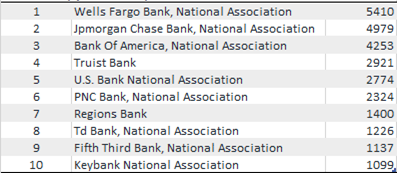
European banks have already announced branch closures and staff reduction, encouraging customers to use internet banking and apps on smartphones. Spanish bank CaixaBank, which announced the purchase of Bankia, plans to close up to half of its 6,300 branches. Only the five largest Spanish banks in 2020 closed about 8% of their branches. The WSJ reports that Kearny consultants estimate that European banks will close up to a quarter of their 165,000 branches in the next three years. However, it is worth nothing that European banks have, perhaps, a redundant retail network. Thus, one of the largest Italian banks, Intesa Sanpaolo, has 5,300 branches, while the largest US bank, JPMorgan Chase, has less than 5,000 branches, Bank of America has just over 4,200 branches in the US, and Citibank, the fourth-largest bank in the US, has only 710 branches. At the same time, today, bank branches in New York no longer gather crowds of waiting customers. The attention of bored branch employee’s is not drawn to customers, but to news feeds, social networking views or other tweets.
The Largest US Banks’ Chains
What is happening in Russia? Banks that announce the reduction of the retail network, do they reduce branches? If you look at the statistics of the Bank of Russia, in 2019 the number of branches of credit institutions decreased by only 2.4%, in 2020 there was a slight acceleration in the decrease in the number of additional offices (-4%) year-on-year to 27.9 thousand. If you look at the largest banks, the Bank of Russia singles out only Sberbank separately, which reduced the number of branches in 2019 by less than 100 units, and, at the beginning of 2020, there were 14.17 thousand branches, and at the beginning of 2021 - 14.08 thousand branches. VTB Group, according to presentations for investors for 2019 and 2020, has practically not changed the number of branches, which is about 1.7 thousand. Thus, the banks reporting on the modernization and optimization of the retail network are too slow, and some do not respond at all to the challenges of the economy.